

"Simplifying complexity"
Cutting-edge advanced analytics for solving real problems

Evolution of analytics
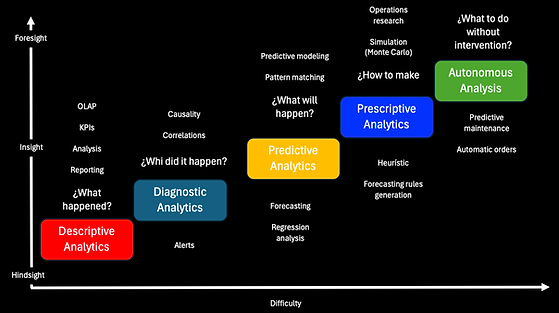
Analytics has evolved from classical statistics to
self-learning algorithms, from:
-
Modeling non-linearities with a high capacity.
-
Incorporating multiple data sources.
-
Delivering adaptive predictions in real time.
-
Delivering greater precision and strategic context, among others.
That is, moving from retrospective analysis (descriptive and diagnostic) to prospective analysis (predictive and prescriptive); from information to optimization.
%201_35_36%E2%80%AFp_m_.png)

Our focus
Predictive and prescriptive analysis for optimization based on the development of autonomous and semi-autonomous AI and Machine Learning solutions.
We transform data and content into deep knowledge to drive decision-making and execute automated actions.
Advanced mathematical modeling
-
Development of complex mathematical models that are presented in processes.
-
Simulation of scenarios for strategic and operational decision-making.
Operations research and optimization
-
Application of optimization algorithms to maximize efficiency, reduce costs and improve the use of assets throughout the value chain.
-
Optimization of production planning, operational continuity, predictive maintenance, inventory management and logistics routes.
-
Optimization of resource allocation and scheduling of operations.
Complex Problem Solving
-
Analytical and structured approach to address non-trivial technical and operational challenges.
-
Interpretation of real-world problems in mathematical formulations to develop and deliver innovative and efficient solutions.
Graph theory
-
Transport networks and supply chain optimization.
-
-
Analysis of flows and bottlenecks.
-
-
Modeling and optimization of supply chain.


